


Do not isolate me at night with nothing but time in my own head. Please.
Anyways: time. I’ve been thinking about the post on time that I wrote a few years ago. This is a bit of an addendum to that.

It’s About Time.
No, I mean it literally is about time; what is it if not an internal experience? Join me in the ramblings of a procrastinator sitting alone in a university library for a couple of hours.

One of the points of the post was ultimately that time is relative, both in physics and in psychology. On the physics side of things, there is no absolute frame of reference in the universe, meaning that you have to measure time “with respect to” or “relative to” a different frame of reference. For our purposes on Earth, our frames of reference are nearly identical, so this is not a concern in everyday life. But when you start measuring time for objects or observers in different gravitational environments or traveling at very fast speeds, weird things start to happen. Namely: time dilation.
In writing that post, I felt two things: 1) that grasping the relativity of time is unintuitive but deeply enlightening for people and 2) that that unintuitive relativity serves a decent analogy for our “psychological” experience of time. While “physically,” one day may pass for two different people, they may experience that passage of time very differently—especially in retrospect. A day of boredom can feel non-existent in your memory, while a day full of novel experiences with a person/people you love is likely to feel like it lasted much longer. I think this is because our minds don’t directly experience physical time; we experience… well, experiences. And a period of few experiences will not occupy as much space in our minds as a period full of adventures and trying new things.
So ultimately, “pursue new experiences if you want to live longer.” Or something like that; I’m mentally preoccupied right now, ask me for sappy advice later.
I just wanted to add an intuitive lens to this analogy that I recently thought of. I call it “Experience-Time Relativity.”
We first have to go back for a moment to relativity in physics. You might have heard that “time is the fourth dimension”—something you thought sounds cool at first before realizing people probably say that with zero idea about what it means. Here’s one way to look at it: every object has a four-dimensional coordinate in spacetime. Again, space is relative and not absolute, so any coordinate system would also have to be relative to some other fixed point in space. Regardless, let’s say we’ve devised a valid coordinate system and we’re plotting the locations of objects in the universe. Intuitively, we might think of there being three coordinate dimensions because we have three dimensions of space. One of Einstein’s main contributions is that, in fact, it may be better to think of there being four dimensions in this context. Accordingly, you would need not only the x-value, the y-value, and the z-value in space to locate an object, but also one value for “where” the object is in time. That’s an important development because Einstein showed us for the first time that everything moves through time at different rates, through different frames of reference. So because we don’t have an “absolute” measure of time in the universe, our coordinate system would be incomplete if we don’t identify objects with their relative positions in time as well.
On a side note, this also makes sense from the philosophical perspective of “eternalism,” which suggests that the past, present, and future all simultaneously exist, even though we as observers are only physically able to observe the present. Under this model of the universe, you would necessarily need to know not only the “where” for an object, but also the “when,” given that all possible “whens” exist at the same time. Stay with me here; if it doesn’t make sense yet, give it time.
The point is that if time is a “fourth dimension,” we can plot the journey of objects through not only space, but also their journey through time. If I went out on a road trip to Vancouver, you could try plotting my journey on just one dimension. That might look like just a straight, horizontal line depicting how far west I travelled. Then, you could add a second, north-south dimension to the plot. With two dimensions, you would have a traditional top-down map, like the kind Google Maps gives you when it shows you your route from Point A to Point B. Theoretically, you could also add a third spatial dimension to the plot, which would depict your altitude. Unless you’re some hardcore geography nerd (or maybe an airplane pilot), that’s not usually super important, so we make do with mapping routes on two spatial dimensions. But again, the point is just that you could have a three-dimensional map if you wanted.
Here’s the interesting part: you could just as easily add a fourth dimension that depicts time. It’s kind of unintuitive to imagine a visualization for four dimensions, but one way to handle it would be to have an animated map that fills out my route to Vancouver gradually, according to the speed I was traveling at each point in my journey. What you’d have ultimately is a four-dimensional map plotting my journey across three spatial dimensions and one time dimension. Not that hard to be a physicist, huh?
Now that we’ve imagined a four-dimensional map, let’s simplify things a lot. Imagine we went back to mapping just one spatial dimension and then we added one time dimension on top of it. This time, because we’d just be plotting two dimensions, we could manage that on a regular Cartesian plane. In other words, we could actually plot the journey of an object through time using regular numerical values. Welcome to the Minkowski Diagram:
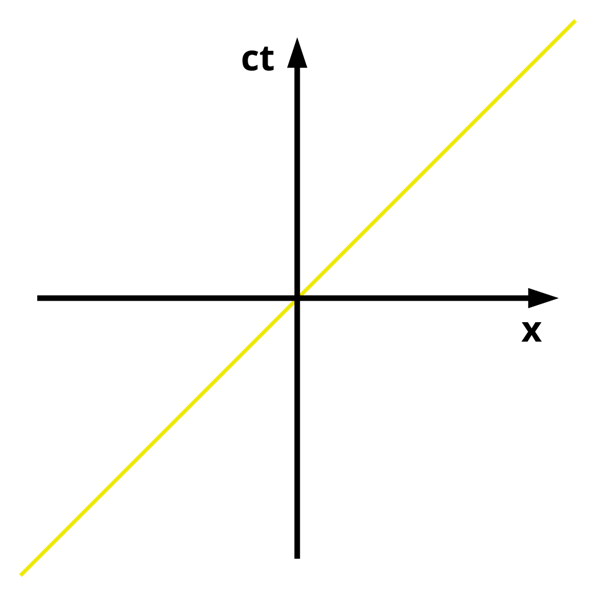
A Minkowski Diagram depicts time on its y-axis and one spatial dimension on its x-axis. Just imagine that all of space is condensed down to one dimension, such that every spatial point in the universe can be placed somewhere on the x-axis. It’s simplified, of course, but it conveys something powerful: that you can plot your journey through time in the same way you plot your journey through space.
You can work out the speed of an object on a Minkwowski Diagram too. It’s effectively just a distance-time graph at the end of the day; the distance between two points on the x-axis represents the spatial distance between them and the distance between those two points on the y-axis determines how much time there is between them. If this is starting to sound familiar, good—because that means the slope of the line between any two points determines the speed needed to travel between them. Come on, that’s kind of cool at least, right?
On Minkowski Diagrams, a line with a slope of 1 depicts the path of a photon (which necessarily travels at the speed of light). You can see that in the example above. Because the speed of light is a constant speed that can’t be exceeded, no object can travel along a line with a slope equal to or greater than 1 (or -1). That gives us the concept of a light cone: the entire possible future and past of an object or event can be captured within a 45-degree cone above and below it. It’s impossible for the object to be affected by or affect anything outside its light cone.
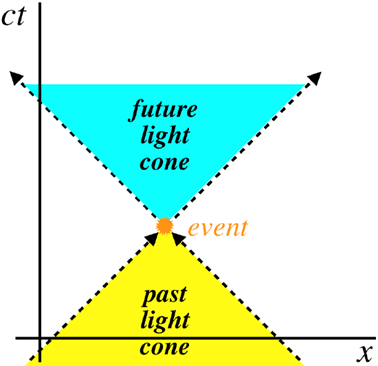
I won’t go too much into that, but it’s an interesting point to ponder if you have a night to kill and a stubborn, anxiety-fueled defiance against sleeping. What’s important for our purposes is the more basic concept of lines on a Minkowski Diagram representing speed and travel through space-time. If you grasp the general gist of what this is all about so far, you’re almost there, I promise.
Take a look at this graph for a stationary object.
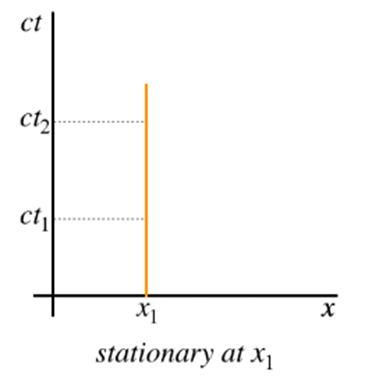
When an object is not moving through space, it still moves through time. The object in the graph above travels through time ct1 and time ct2, even though it remains stationary at x1.
Now, look at this graph of an object that is moving through space at a constant speed.
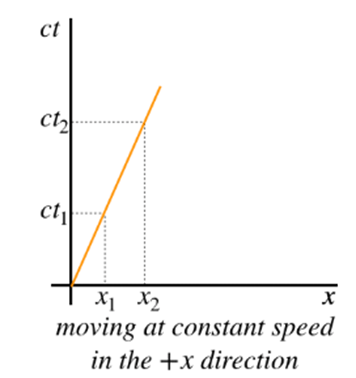
This object still goes through time ct1 and time ct2, but it also travels through position x1 and position x2. The most important observation here is that the length of the segment between ct1 and ct2 is longer than for the stationary object in the previous diagram. That makes sense mathematically because the second diagram shows a line with the same distance along one dimension (between ct1 and ct2) while also traveling through a second dimension (x1 to x2). This is also exactly why the hypotenuse is the longest side of a right triangle.
The big implication of this is that the moving object experienced “more time” from its frame of reference than the stationary object. Just take that conclusion for granted and ignore the rest of this paragraph if it makes no sense, but here’s a short explanation. If you were to rotate the Minkowski Diagram such that the line of the moving object became vertical, you would essentially have a new diagram drawn from the frame of reference of the object itself. In that new frame of reference, the original line of travel for the object serves as the y-axis. What used to be ct1 and ct2 are now two new points that lie along the new y-axis. Due to the rotational transformation, the y-values for those two points has increased. The absolute distance between them has increased, too. If the original points had y-values, for example, of 5 and 10, the two new points might have y-values of 7.5 and 15. The only conclusion that can be drawn is that, from the frame of reference of the moving object, 7.5 time units elapse while traveling from x1 to x2, even though only 5 time units elapse from the original frame of reference.
Another way to put it is that the moving object traveled more “slowly” through time than the stationary object. This is what time dilation is about, but framing it in this way leads us to the most profound realization: every object is traveling through space-time at a constant speed; that speed is allocated either to the object’s “speed through space” or the object’s “speed through time.” As an object travels faster through space and its “space speed” approaches the speed of light, its “time speed” approaches zero. And vice versa: an object travels through time at it fastest possible speed when it is completely stationary (with respect to a reference frame). This works in the same way that a car travels slower laterally if it’s on a slope because part of its speed is being devoted to traveling through a second dimension (altitude). Time being a “dimension” allows us to reach this conclusion. To me, it’s cool how intuitive this is.
Alright, we walked through all the theoretical groundwork, I promise. The entire reason I brought all this up is because I think this understanding of space-time relativity can be exported super naturally to our understanding of psychological time. I left the details vague last time, but my confidence has grown in the idea that periods of novel experience “feel” longer in our memories than sedentary periods of no activity. You might be picking up on where I’m going with this already.
My assertion is that time and “experience” are relative in the psychological context in the same way that time and space are relative in physics. You could create a Minkowski Diagram that depicts one dimension of time and one dimension of “experience,” however that might be measured, and you could import the same conclusions we drew about relativity a few paragraphs ago. We all travel through experience-time at constant speeds. But traveling “faster” through experience (i.e. having more experiences in a given period) reduces your “speed” through time, making you feel like you experienced more time than if you were just sedentary and couch-rotted the whole time. Don’t look at me.
And in the same way, the fastest way to go through time and get your life over with as quickly as possible is to have no experience whatsoever. To disappoint Avicii’s father and live a life you won’t remember. One where you look back at the past 70 years and realize nothing of note happened.
Memories of experiences define our perception of time. At every moment, you’re either accelerating at maximum speed towards death, or you’re slowing yourself down by experiencing life. So get busy living or get busy dying.
 Common Sense