

Capitalism and free market principles can only truly thrive in a market with perfect competition. The reason for the existence of economic study is that resources are scarce and decisions must be made on how to allocate them best. I talked about this in greater detail in the first post on this blog. Each economic system handles resource allocation differently. The one that is freest from government coercion is known as capitalism. The theory behind this system is that resources will naturally be allocated most efficiently without government intervention. The reason why this works is that every business requires clients in order to make money; no person can make a profit without engaging in transactions. This reliance on customers results from competition in the market. In an economy with a limited number of spenders, businesses selling similar products must compete with each other to win over the greatest number of customers possible. Demand as a mechanism ensures that there is passive democracy in a market with perfect competition. In other words, if a business sells poor products or treats its customers badly, it will lose money. These customers will go to a different business instead. Likewise, if a company produces things that people want, it will grow. In this way, sellers in the free market are required to continuously innovate and remain efficient to stay competitive. None of this applies in a monopolistic or oligopolistic market, however. To clarify, a monopoly refers to a situation in which a single business is so big that it has total control over the supply of a particular product. Oligopolies are more general; any situation in which supply is concentrated in the hands of a few (but not necessarily just one) is an oligopoly. In these scenarios, the demand mechanism loses its power because there is little to no competition. When buyers have limited choice, sellers lose the incentive to try to please the market as they know that they will secure customers regardless of what they do. Thus, in an oligopolistic market, capitalism fails; sellers do not need to innovate, please customers, or lower prices in order to attract business. The obvious general conclusion can then be drawn that oligopolies are bad for society.
Why then do we allow one to exist in one of the most crucial markets by far: government?
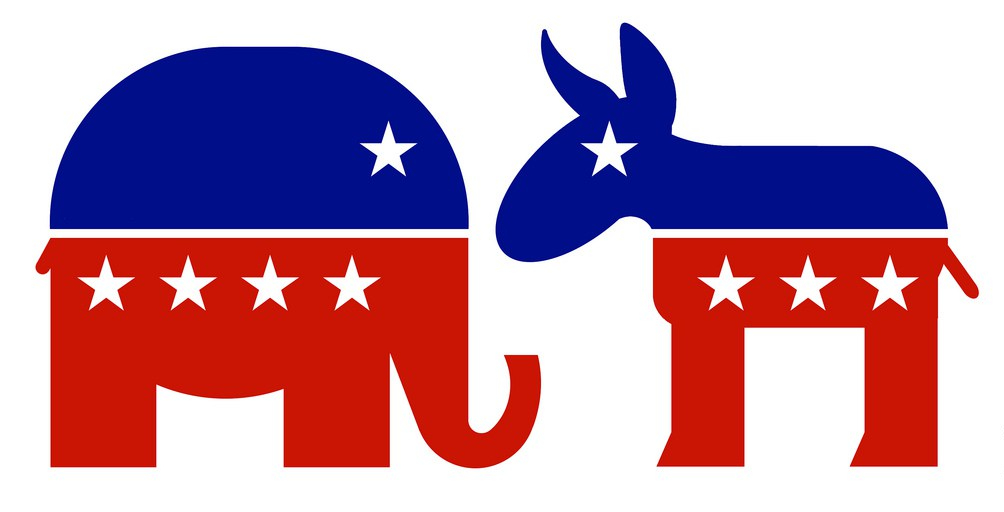
Just like in a free market, partisan oligopolies produce undesirable outcomes. An example of one is the two-party system of the United States. For the vast majority of its history, legislative power has been shared between two parties: the Democratic Party and the Republican Party. This leads to a lack of diversity in political beliefs, a platform for corruption, and mob mentality resulting from hyper-loyalty.
With only two parties dominating the government, politics boils down to a massive general ‘left’ vs ‘right’ game. The Democrats espouse a generally liberal set of views while the Republicans hold the opposite. The problem with this is that it causes a trivialization of politics. Most of those on the ‘left’ do not come close to agreeing with all the views of the Democratic Party and the same goes for the Republicans and their voter base. However, they keep getting elected for two reasons. The first is that the parties don’t often discuss their ideas in depth and instead, as stated before, use general terminology to win over the greatest number of voters by keeping them uninformed. By rallying voters behind an umbrella theme, parties can shift focus away from specific policies. A clear example of this is the current Democratic Party’s platform which is almost exclusively about opposing Donald Trump above all else. With a president as polarizing as the current one, having a message as simplistic as just generally being in opposition to him is enough to remain relevant and perhaps even make a comeback this midterm election. If there were multiple left-wing parties, they would currently need to be competing to win the anti-Trump vote. However, with a monopoly on the left, the Democrats know they are guaranteed a large slice of the electorate regardless of what other policies they may have. Of course, the Republicans are guilty of this too, with their reliance on primarily opposing extreme progressivism and protecting uber conservatism. This shows that there is no incentive for elected officials to ‘innovate’ and advocate for policies that differ from the mainstream. Thus, even if many people do not realize it, most of the US public is not truly politically represented in government. Therefore, one effect of a partisan oligopoly is an extreme trivialization and, at least in the US, binarization of what should be a complex set of issues.
Another problem with a limited number of parties in government is that it allows for a platform for corruption. This is because political parties usually operate with some level of both central funding and planning of policy positions. Assuming the source of funding at least to some extent affects policy planning, it should be easy to see that political parties can essentially turn into tools that special interests can use to ensure governments that act in a friendly manner towards them. This is especially true in an oligopolistic government; the more power a corrupt party has, the more power its donors have. The oversimplification of politics as an effect of monopolistic parties discussed in the previous paragraph allows parties to do this without losing votes. As long as a party represents a blanket ideology that covers a big enough sector of the populous, its voter base will not care what small tweaks it may make in order to appease its special interests. Again, even if people do notice and care, due to the nature of an oligopoly, they do not have alternatives to vote for instead. If there was a high level of competition, one can assume that many parties would achieve success through mere differentiation in fundraising techniques from other parties; in fact, one reason for Bernie Sanders’ unprecedented success in 2016 was his refusal to take any money from Super PACs and instead rely almost wholly on individual contributions.To sum up, corruption is allowed to thrive in a partisan oligopoly because the massive level of influence of the parties appeals to special interests and because there is no competition to provide those legitimately fed up with corruption with alternatives.
The final major issue with a limited-party system is that it potentially leads to unhealthily polarizing partisanship and mob mentality resulting from large-scale blind loyalty. When a nation has parties the size of the Democratic Party and the Republican Party, affiliations become all-encompassing labels. What party one is a member of becomes ingrained into one’s identity. As such, people often choose to associate with a particular party for reasons as trivial as family beliefs, peer pressure, etc. Referring back to a statement made two paragraphs ago, large parties enjoy keeping the public uninformed about specific issues. With this in mind, one can only imagine how deeply rooted partisan identity can be in those who grow up in politically homogeneous ‘bubbles’.This feeling is amplified in a two-party system because politics begins to feel like a perpetual one-on-one competition for many. This means that a large number of people vote based on deep-rooted personal alliances and a general hatred for ‘the other side’. This is even more worrying when one considers the fact that many of these voters are also uninformed on the specific issues.
Partisan oligopolies are no different from those that occur in regular markets; all yield negative results for consumers/voters. Just as market oligopolies lead to inefficiency, slow innovation, and higher prices, partisan ones lead to a lack of diversity in political thought, platforms for corruption, and voters making decisions with mob mentality. In a perfect world, there would be no parties at all and officials would have original ideas that the electorate would be informed enough to vote on. However, this can potentially lead to great inefficiency in government as many compromises would need to be made in order to come to a majority agreement on anything. Still, at the very least, barriers to entry for smaller parties should be removed to encourage competition in government.
We’ve heard politicians talk about free-market ideas for a long time – now let us see them represented in government operations.


Good thought – so no end in sight for this dilemma??
LikeLike